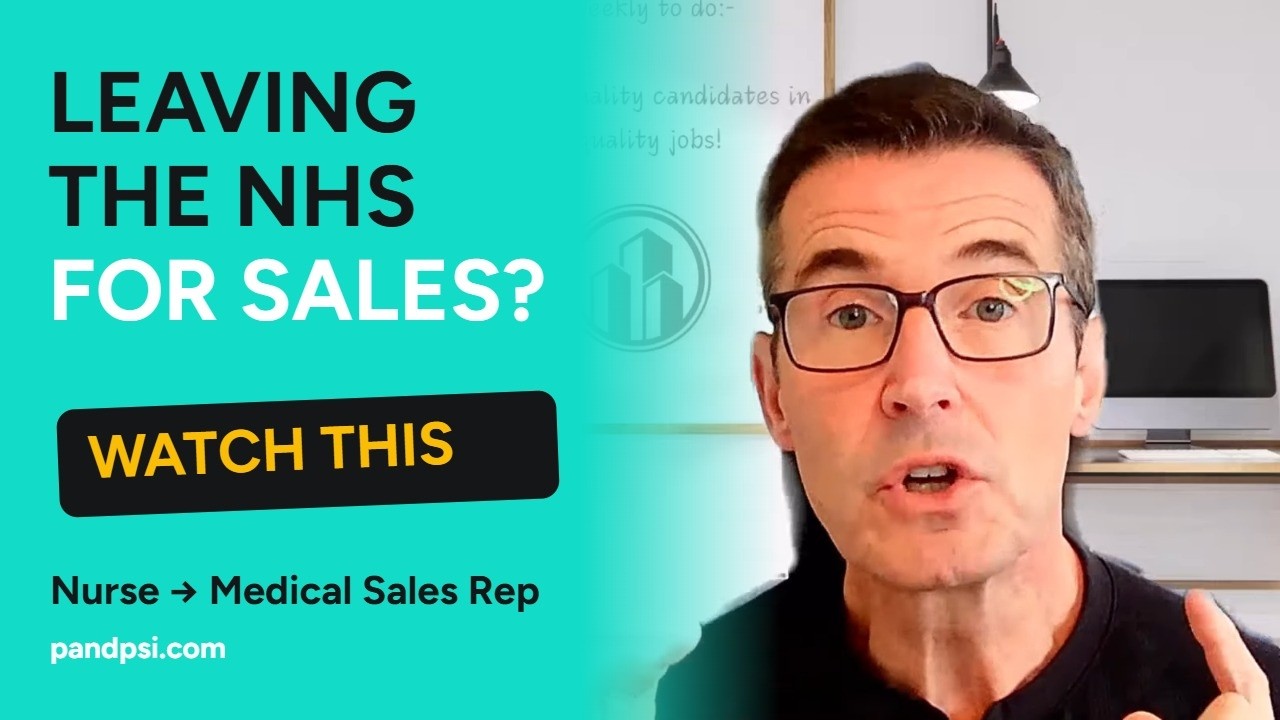
“Can I, as a clinical nurse in the NHS, move into a commercial medical sales job?” It’s one of the questions I get asked most. The answer is yes, absolutely you can. But it isn’t easy, so in this video I explain what you already have, what you’re missing, and how to rewrite your CV so a medical device company sees a future sales hire.
Key points
- You already have something new sales reps don’t. You know the NHS processes, systems and departments, and you already talk to surgeons, doctors, ward managers and project teams every day.
- The honest bit: you don’t have sales experience. Expect to start at sales specialist or territory manager level rather than senior sales manager.
- You’ll probably take a pay cut compared with your NHS package of overtime, pension, holidays and sick pay. Think of the bigger picture: a step back to go forwards. With your clinical background you’ll progress faster.
- Rewrite your personal statement. Say clearly that you’re a clinician who wants to move into medical sales, and name your specialisms and the devices you’ve used.
- Turn clinical duties into commercial achievements. Not “I did clinical duties” but “I trained 40 nurses on the XYZ device”. Include product launches, ward refurbishments and project work.
- Any commercial experience counts, even customer service or telesales from years ago. Match your LinkedIn profile to your CV.
- It can be done. Many of the commercial leaders I work with started out in clinical roles and now hold senior leadership roles in medical device companies.
Video transcript
Hi everybody, it’s Stuart from People and Process Solutions. Today I want to answer a question that I get asked all the time: can I, as a clinical nurse in the NHS, transition into a commercial medical sales environment?
Well, the answer is absolutely you can. But the flip side is it’s not very easy, as you’ve maybe discovered already, which might be why you’re asking me in the first place. So let me just explain a few things that could help and point you in the right direction of what can be done.
So the first thing to consider is what you have that a junior salesperson, who’s doing his first job selling into the NHS, doesn’t have. What you have as a clinical person is knowledge about the processes, the systems, the people within the NHS and the various departments. You have already broken that mould. You can already talk to surgeons, to doctors, to project managers, to patients, to ward managers. You know how to do that because you’ve been doing it. You’re a clinical person. That is what you can do – you do that in your daily job. So you’re already one step ahead compared to somebody coming into medical sales for the first time. So that’s a tick. It’s all about ticking boxes, getting jobs.
The honest bit is what you don’t have, and what you don’t have is sales experience. That’s what you’re looking to get, but you don’t have it. As such, because there’s a piece of experience missing, you’re probably going to have to think in terms of a slightly lower-grade job – an entry-level sales job. That might not be the news you want to hear, but that’s probably what you’re going to have to take. So pitch yourself at a sales specialist role rather than a senior sales manager role.
If you’re in the NHS and you’re working overtime – I know some of you work six or seven days a week and lots of hours – you’re probably earning a considerable amount of money, hopefully, and you’ll get a nice package. You’ll get a nice pension, decent holidays, sick pay and all the other things that make life nice. If you go into a commercial job and it’s your first one, you’re probably going to have to take a pay cut. In fact, I would say it’s more than likely you’re going to have to take a pay cut. But you’ve got to think about the bigger picture. The bigger picture is: I can take a cut here to get to a more senior position there in a period of time.
The good news is that if you manage to get yourself a junior sales position, you will probably progress faster, because you have all that lovely clinical experience we talked about at the beginning. So you’re going to progress quicker.
The hard bit, of course, is getting your first foot in the door. So let’s talk about that. How are you going to get your foot in the door? The first thing to consider is your CV, because it’s your CV that represents you – and then probably your LinkedIn as well, which will need to match your CV. But CV first.
You’ve got your name, your address and all the other things, and then a personal statement. I had one the other day. The lady in question wanted a position in a commercial environment, and she’d been clinical. Her personal statement was five or six lines – very nice, thank you very much – but all it mentioned was clinical things. If you want to go commercial, it needs to say that you are a clinical person, that you want to transition into a medical sales environment, and that your specialisms are this, this and this. Maybe you can say you’ve used this type of device or that type of device. That would be brilliant. So it says right at the beginning who you are and what you want: “I want to transition into medical sales.” It makes it blatantly clear.
Then, in the jobs you’ve had in your clinical environment, you need to take them away from being patient-focused and more into what you did that helped the business – i.e. the NHS. So instead of saying something like “I did clinical duties”, you could say something like “I trained…” – because a lot of early jobs into sales are almost sales-trainer-type jobs – “I trained 40 nurses on the XYZ device”. Talk about that type of thing rather than “I did this on a ward, I did that on a ward”, because that’s not really going to get you the commercial job. It’s not commercially focused.
So take the information on your job, turn it on its head and think about the commercial side of things. Training. If you helped launch something. If your ward had a refurbishment and you helped manage that. If you worked with a project team. Think about all the things you do on a daily basis outside of your clinical duties that would make you valuable to a commercial organisation. That’s what you need to do with your CV: take that clinical information and make it into something that would be valuable to a commercial organisation.
If you do those things and you focus your CV on sales specialist / territory manager type roles – which will pay less, unfortunately, than what you’re on now, so it’s a backward step in order to go forwards – then you will get interviews. And when you get the interview, of course, you’ve got to convince the hiring manager that you can sell.
I would also say, if you’ve done anything outside of your clinical career that’s commercially orientated – even if it was early on, when you were at school and you did customer service, or you worked in telesales, or anything like that – get that on your CV, because it shows competence in dealing with people on a commercial basis. Get that on your CV too.
Get that CV sent over for various jobs, pitch it at the right level, and I’m absolutely convinced you will get interviews.
Interestingly, quite a number of the commercial leaders I deal with started life in clinical positions and have transitioned through and up into senior leadership roles within medical device companies. So it can be done, and you can be successful after you do it. It’s just not very easy.
I hope that helps. I’ll be posting other tips to help people in their career journeys on the website and on LinkedIn. Bye for now.
Clinical and thinking about a move into medical sales? Send me your CV or see our current jobs. Hiring medtech, medical equipment or life science talent? Get in touch or call 01904 233080.
HIRING IN MEDTECH OR LIFE SCIENCES?
We recruit sales, technical, quality and senior people across the UK and Ireland: Medical Equipment · Medical Devices · Pharmaceuticals · Healthcare IT · Dental · Quality & Regulatory · Executive Search. See how we work with employers
LOOKING FOR YOUR NEXT ROLE?